
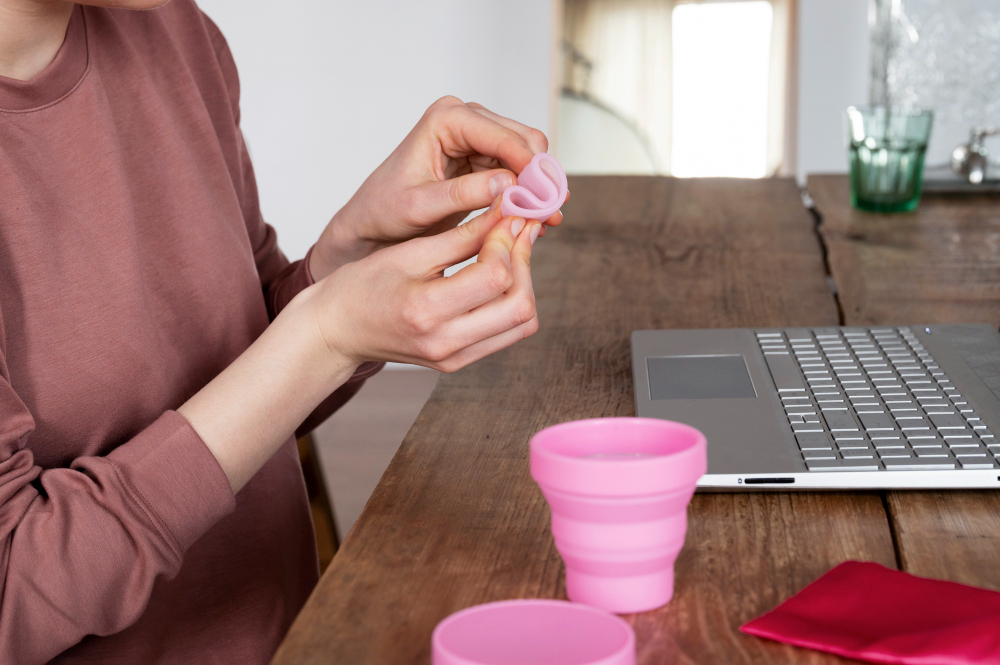
A desk station is not a loophole around the lactation room. If you sit in an open bay, your desk is not a private space under the PUMP Act. What a desk station is: a 12-inch kit that lets you start a wearable pumping session without a scavenger hunt, plus a place to park milk and parts between empties.
If you have a door that closes, you can do almost the whole routine at the desk. If you do not, the desk holds the kit. The room handles pouring.
Two layouts, not one fantasy
Closed office or lockable room assigned to you. You can run the session, pour, and fridge-hack parts without leaving. You still want a sign or a lock. A colleague walking in mid-session is how people quit the schedule.
Open plan or hot desk. Keep the wearable, wipes, and cooler in a drawer. Start the session only if your outline is hidden and nobody is camera-facing your chest on video calls. Walk to the provided private room to pour. That room is the station. The desk is storage.
Employers with 50 or more employees must provide a private, non-bathroom space for one year after birth. Asking for a mini-fridge in that room is reasonable. Asking to skip the room because you bought a wearable is how you lose the only lock you have.
The 12-inch kit (what actually needs to live at the desk)
- Wearable cups in a case or sleeve
- One spare set of valves/membranes (they fail on the day you have a 10 a.m. review)
- Pump wipes
- Milk bags + a marker
- Compact cooler + ice packs, or a labeled hard container if you have fridge access
- Water bottle (16–20 oz before a session is boring and it works)
- Phone charger if you run the session from an app
You do not need a bottle drying rack, a full-size cooler, or a photo collage. Those belong at home or in a dedicated lactation room. A desk that looks like a dairy aisle is the opposite of discreet.
Outlet: optional if the wearable has all-day battery. Required if you are still using a wall-plug pump. If Facilities will add one outlet in the lactation room, take that over a power strip under your monitor.
Room vs desk: who does which job
| Task | At the desk | In a private room |
| Start/stop a wearable session | Yes, if visually private | Always fine |
| Pour milk, bag, label | Only behind a closed door | Preferred |
| Wash parts | No | Sink, or fridge-hack then wash at home |
| Store milk | Cooler with ice packs | Fridge, labeled, sealed |
| Video calls | Camera off or framed above the chest | Do not take calls while pouring |
Fridge-hack, CDC-aligned: used parts in a clean sealed bag in a fridge for up to about 24 hours, then a full wash at home. Do not leave wet parts in a warm desk drawer.
Pumps that shrink the station
The station gets smaller when the pump does not need a table, tubes, or a wall plug for every session. The folloiwing are the wearable electric breast pumps you can choose:
Air 1 — the drawer-sized station
What we like: 61mm cups plus a wireless charging case that holds about 15 sessions. The case is the station. No cable nest. Transparent top so you are not opening your shirt to check volume on a video-call day. Sensor app reminders keep the 10 a.m. hold real. $369.99 double. DME upgrade often $50–$300.
Worth noting: Premium price, double only. You still need a private surface to pour. The case does not replace a lock.
M5 Smart — smallest spend, lightest cups
What we like: 230g, $199.99 double, 4 parts to clean, Type-C, about 6 sessions, 30-minute auto shut-off so you do not forget a cup during a standup. App start from your phone while you sit.
Worth noting: Thicker than Air 1. Plan on a Type-C cable in the drawer. Fine for a normal office day, not a 15-session travel week.
W1 — if the desk is a closed office and let-down is the hard part
What we like: Warm-massage sync at 38–40°C (SoftPulse and HugWave), app control from your phone so you are not fishing under a shirt between emails. After a tense meeting, comfort is usually what stalls output, not a missing outlet. About 10 sessions per charge with warmth off, about 6 with warmth on. 295mmHg, 180ml cups, $329.99 double.
Worth noting: At 320g and 78mm it is the heaviest, thickest of the three, so it is a poor hide under a fitted knit in an open bay. Use it when you actually have a door. Charge nightly if you run warmth on a 3-session day.
How to ask Facilities without making it weird
Write one email: you need a lockable, non-bathroom space with a chair, a small table, and preferably an outlet and mini-fridge, for one year after birth, citing the PUMP Act. Offer to use a spare office. Copy HR. Ask for a written yes or no.
If they stall, keep pumping in whatever private space exists and document dates. DOL Wage and Hour takes these complaints. A pretty desk tray will not fix a missing room.
FAQ
Q: Can I pump at my desk at work?
Yes if you have visual privacy and a wearable that does not require undressing. Pouring milk at an open desk is a no. Open-plan employees should still use the legally required private room for handling milk.
Q: What do I need for a pumping station at work?
A lockable space, a chair, a flat surface, a way to keep milk cold, wipes or a fridge-hack for parts, and a pump you can start in under a minute. An outlet is optional with a charged wearable. A sink is nice. A spa is not required.
Q: Is a desk considered a private pumping space?
Not in an open office. A private space means shielded from view and intrusion, and it cannot be a bathroom. A closed individual office with a lock can qualify. A bench desk cannot.
Q: How do I store pump parts at my desk?
Do not leave wet parts in a drawer. Fridge-hack in a sealed bag, or wipe and use a second dry set. Wash fully at home each night.
Q: Do I need an outlet at my desk to pump?
Not if you use a wearable with enough battery. Air 1’s case covers about 15 sessions. M5 Smart and M9 need a nightly charge. Wall-plug pumps still need an outlet in the private room.
Bottom Line
Build a tiny kit at the desk and keep the lock somewhere else unless your office actually closes. Air 1 turns the kit into a charging case. The law still wants a room. A tidy drawer is logistics. It is not a substitute for a door.